
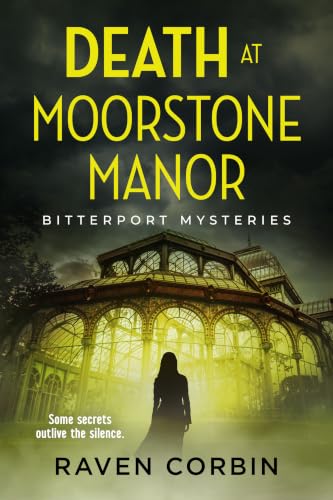
Death at Moorstone Manor · Bitterport Mysteries Book 4
Author and Book Details
- . Author's name:
- Raven Corbin
- . Book or series being promoted:
- Bitterport Mysteries
- . Book number in the series:
- 4
- . Genre:
- Cozy Gothic mystery
- . Publication or release date:
- 7 December 2026
. Book description/blurb:
A reluctant inheritance. A murdered caretaker. And forty-three dead women demanding justice.
Graphic designer Nina Drake has spent her entire adult life pretending she cannot see the dead. When a mysterious benefactor leaves her Moorstone Manor—a crumbling sandstone estate in the abandoned town of Bitterport—her plan is simple: sell the ruin and escape back to Melbourne.
Instead, she arrives to find the manor’s caretaker murdered in the conservatory, surrounded by spirits she can no longer ignore.
Paranormal investigator Kason Eady has spent months researching the estate’s dark lineage. Once a notorious Female Factory full of convict women, Moorstone hides secrets that someone has spent generations protecting.
Guided by the ghost of a young convict girl from 1845, Nina and Kason uncover a sinister trail leading directly to one of Tasmania’s most powerful families—and a blood-soaked history they will do anything to protect.
Some inheritances cannot be sold. Some debts cannot be avoided. And the dead are done being quiet.
2. All About Your Book
9. Tell us about the book you're promoting. What's the story about?
Death at Moorstone Manor is the fourth book in the Bitterport Mysteries, a collaborative gothic mystery series set in an abandoned Tasmanian coastal town. My book centres on the old Female Factory — a place built on the documented reality of Van Diemen's Land convict past — and the ghost of a young woman whose story was never properly told. It's part mystery, part history, and entirely haunted.
10. What inspired the idea behind this particular story?
A visit to Port Arthur. I stood amongst the ruins and forgotten memories and simply listened to what the air had to tell me. I imagined what life must have been like for the convicts and for their captors. That's when the stories and ideas took hold. Tasmania's history is remarkable and sometimes very dark. Once you start digging, the voices beg to be heard.
11. Who is your main character, and what makes them interesting, loveable or perhaps a little difficult?
Nina Drake is a psychic medium who has spent years pretending she isn't. As a content creator, her whole job is showing the world who she is, which makes it ironic that the one thing she's never shown anyone is her most defining trait. She's learned to look, sound and be normal, and she's been very good at it. What makes her loveable is that underneath all that performance, she's someone with the capacity to listen to the living and the dead alike. She just hasn't let herself do it.
Then she arrives in Bitterport. Kason Eady is a history professor turned paranormal investigator, a man who has spent his career taking seriously the things most people dismiss. He doesn't need Nina to pretend. For the first time, her gift isn't something to hide; it's something that matters. And the women who still reside at Moorstone Female Factory aren't going to wait quietly while Nina decides whether to trust that. What I love about Nina is that she doesn't become brave all at once. She becomes braver, gradually, because the alternative — leaving those women unheard — becomes something she simply can't do.
12. Is your story set in a real location, or have you created an imaginary world? Why did you choose that setting?
Bitterport is fictional, but it's built from real Tasmanian history and geography. The Moorstone Female Factory doesn't exist, but the female convict establishments it's based on did, and the stories of the women who passed through them are very real. Getting that right mattered enormously to me.
13. What can readers expect from your book? Romance, mystery, humour, suspense, adventure, heartbreak or something completely unexpected?
Mystery with genuine historical weight, a ghost who has very good reasons for not moving on, a slow-burn romance, and the grey, wet cold of Tasmanian weather. Hopefully also something completely unexpected in terms of the mystery elements.
14. Was there a particular scene or character you especially enjoyed writing?
The characters I enjoyed writing most weren't the living ones. Margaret, Polly, and Constance — the three women who still reside at Moorstone Female Factory — each arrived from a different era, with a different story, a different wound. The challenge was making sure they weren't simply variations on the same tragedy. Each one had to feel like a complete person, not a symbol of suffering.
What I discovered is that ghosts who hang around do so for very specific reasons. They're not vague presences. They're people who have unfinished business important enough to keep them here across centuries. Finding that specific thing that couldn't be let go was the most satisfying work in the whole book. Margaret holds the memory of what the Factory was. Constance holds the anger. Polly holds the evidence. Together, they're everything Nina needs and didn't know she was capable of handling. Writing the three of them as a fractured chorus, each telling part of a story none of them could tell alone, felt like the most genuinely real thing I've ever written.
15. Did any part of the story surprise you as you were writing it?
So many things surprised me about this book that I've started to wonder whether "surprised" is just what writing feels like when it's going well.
The biggest surprise was how the clues hid themselves. I know that sounds odd. I mean, surely the author decides where the clues go? Apparently not! There's something that happens in a mystery set inside a building with this much history, where the walls themselves are part of the story. I'd be writing what I thought was a purely atmospheric scene only to realise later that I'd buried something special in it. A detail that seemed like texture turned out to be evidence. A line of dialogue that felt like character work turned out to be confession.
The three ladies of Moorstone had a great deal to do with this. When your witnesses are ghosts who can only reveal what they know in fragments and who have their own reasons for how much they tell and when, the pacing of revelation takes on a life of its own. I didn't always know what I'd hidden until Nina found it. Which I think means she's a better detective than I am.
16. If your book were made into a film or television series, who would you love to see playing the main characters?
This question is dangerous because now I'll never be able to un-see it.
For Nina, I'd love Mia Wasikowska. She has watchful intelligence that suits someone who's spent years pretending not to notice things she absolutely notices. And for Kason, Aidan Turner. He has the right amount of intensity, the kind of presence that makes you believe someone would walk into a haunted female factory and find it fascinating rather than terrifying.
The ghost casting is where it gets interesting. The three women of Moorstone are not interchangeable. They each carry a different wound from a different era, and the actresses need to feel like they belong to different times even when they're in the same room.
Noni Hazlehurst as Margaret: she has the deep sorrow that feels exactly right for someone who has been holding the memory of this place for a very long time.
Sarah Snook as Constance: controlled fury just beneath the surface, the anger of someone who never got to be heard and hasn't forgiven anyone for it.
And Thomasin McKenzie as Polly: young, determined, steel in her spine; someone who knew exactly what was happening and tried to make someone listen.
That’s a movie I’d watch!
17. What do you hope readers feel or take away after finishing your book?
That history matters, and that the people who were silenced deserve to be witnessed. The mystery gets solved but the deeper questions linger, the way they should. I hope readers finish the book feeling like they've paid attention to something that was owed attention.
18. Are you currently working on another book? Can you give us a little sneak peek at what's coming next?
The next Bitterport book centres on St Eleth's Church, which has been quietly watching over the town since 1839 and has plenty of its own secrets. Title to be confirmed, but the ghosts are already talking.
3. Your Writing World
19. Are you a plotter who plans everything, or a pantser who lets the characters lead the way?
Somewhere in between. I need to know the beginning, the end, and the major turning points before I start. Everything in between is negotiable, and my characters frequently renegotiate it without asking me first.
20. Where do you prefer to write? Do you have a favourite writing space?
My desk faces the window that looks out on my garden, a peaceful place with a koi pond and bench I like to sit on with a cup of tea. Much like Nina and Margaret do in the conservatory in Death at Moorstone Manor.
21. Do you have a daily writing routine, or do you write whenever inspiration strikes?
I write when the inspiration strikes and every Tuesday on my RDO. If an idea strikes at work, I jot down the idea in my notebook.
22. What writing software or tools do you use?
I use Atticus to write and format which is new to me. I used to use Scrivener for writing but I find Atticus much easier.
23. How do you handle writer's block or those frustrating days when the words just won't come?
These days, writer's block doesn't phase me the way it used to. I used to panic and tie myself in knots over letting readers down, especially mid-series. But fourteen years in, I've taught myself something important: I can only do what I can do with the hours I have. Finding the balance between work, family, and writing has been its own kind of journey. I'm still here, and so are the books. The words come when they're ready. In the meantime, I take walks, drink tea by my pond, and wait for the inspiration to find me.
24. Do you research your stories extensively, or do you prefer to write from imagination and personal experience?
Extensively is an understatement for the Bitterport books. The history of Van Diemen's Land's female convict system required a lot of reading — official records, academic histories, personal accounts where they existed. The silences in the archive were as important as what was actually documented.
25. Do you have an editor, beta readers or a trusted group of people who help you refine your manuscripts?
The Bitterport series is published by Tule Publishing with Kelly Hunter as series editor, so there's a full editorial process behind each book. Before it gets there, Kerrie, Suzanne and I read each other's manuscripts and give feedback to make sure we've captured characters and locations consistently across the shared world, which matters more than it might sound when three authors are writing the same town.
I also have trusted readers who know when something isn't working and aren't afraid to tell me so. That honesty is worth more than any amount of enthusiasm.
26. What's the most valuable thing you've learnt about writing since publishing your first book?
That the story you think you're writing is usually not the story you end up writing, and the one you end up writing is almost always better.
4. Your Publishing Journey
27. Are you independently published, traditionally published, or a little of both? Why did you choose that path?
Both. The Bitterport Mysteries are published through Tule Publishing Group. Some of my other work has been self-published. My first books were traditionally published with Harlequin. Each path has taught me something the other couldn't.
28. What has been the biggest challenge in your publishing journey?
Time. There is never enough of it.
Put me in a quiet room and I can write for hours. The words come, the story moves, the worlds open up. The challenge is finding that quiet room inside a day that also contains work, family, bills, and a mortgage. Writing isn't my sole income, and that reality shapes everything: the pace I can write at, the deadlines I can commit to, the headspace I can give to the stories.
It's the dream, of course, to write full-time and not have to juggle. I'm not there yet. But I'm still writing.
29. What do you love most about being an independent author?
The control, particularly over timing and cover direction. When something needs to move fast, it can. When you want to take a creative risk, you can. Traditional publishing offers the team and the reach; indie publishing offers the agility.
30. Where are your books available?
Through all major online retailers — Amazon, Kobo, Apple Books, Barnes & Noble — and via the Tule Publishing website for the Bitterport series.
31. Are your books available in ebook, paperback, hardcover or audiobook formats?
Ebook and paperback. Audiobooks are still on my radar — it's something I'd love to do — but the production costs put it out of reach for now. Whether AI changes that equation remains to be seen. It's too early to tell, and I want to get it right before I commit to anything.
32. Who designed your book cover? How involved were you in the creative process?
For the Bitterport series, Tule Publishing uses their in-house cover designers. I submitted my vision and they brought it to life. It's a collaborative process, and I've been happy with the results. For my self-published titles, my go-to is Patti Paradox Book Covers & Formatting), who has an uncanny ability to know exactly what I want, sometimes before I've fully articulated it myself. That kind of creative shorthand is rare, and I don't take it for granted.
33. How important do you think book covers are when it comes to attracting new readers?
Enormously. The Bitterport covers had to signal gothic mystery immediately with the right atmosphere, colour palette, and sense of unease. A cover is a promise to the reader about what's inside.
34. What has worked best for you when promoting your books?
Genuine connection in reader communities, blog features, and word of mouth. Readers who love gothic mystery and historical fiction tend to be enthusiastic recommenders. The best marketing I've ever done has been a good story that readers want to tell someone about.
35. Have you experimented with reader newsletters, pre-orders, advance reader copies (ARCs) or book promotions?
All of the above, some with success, some without. The honest truth is that I'm a small fish in a very big pond, and finding ways to cut through the noise is getting harder every year. The tools exist. The challenge is making them work when you're also the one writing the books, managing the newsletter, and doing everything else that comes with being an indie or small-press author. It's a lot of plates to keep spinning.
36. What advice would you give a new author preparing to publish their very first book?
Get your story in front of readers before you feel ready. Waiting for perfect means waiting forever. And find your community early: other authors, readers, reviewers. Publishing is not a solo sport, whatever it looks like from the outside.
5. Artificial Intelligence and the Future of Publishing
37. What are your thoughts on artificial intelligence becoming part of the modern writing and publishing industry?
It's here, it's not going away, and the conversation is more nuanced than most headlines suggest.
The meaningful question isn't "AI or not AI", it's "what is the author actually bringing?" A story built on a genuine visit to Port Arthur, years of historical research, and real emotional investment can use AI as a tool and still authentically be that author's work. The secret is in the editing. If you think you can drop an idea into AI, let it write a story, and publish the result without reading it from start to finish, then you have another ‘think’ coming. Some have done exactly that, and the comments calling it "slop" speak for themselves.
I dislike that term intensely. I prefer "unrefined." Not all AI-assisted writing deserves the same label. Similar things were said when self-publishing arrived. Everyone feared the market would be flooded with unreadable work. Yet here we are, with traditionally published authors turning to self-publishing when their books no longer meet sales targets but their writing dream isn't over. The industry adapted. It will adapt again.
38. Have you experimented with AI tools in any part of your creative process?
Yes — for brainstorming, marketing copy, structuring ideas, and working through plot problems. I use it the way I'd use a very well-read sounding board. The story is mine. The voice is mine. AI helps me find them faster.
39. Do you believe AI can make independent publishing more affordable and accessible?
Absolutely, particularly for authors (like myself) who can't afford to outsource everything. Cover design assistance, editing support, marketing copy — these are real costs that keep talented writers from publishing. Anything that lowers that barrier is worth taking seriously.
40. How do you feel about using AI-generated imagery or AI-assisted editing in book-cover design?
I'm not against it, as long as the cover matches the title and the story it's selling. That's the standard I hold any cover to, regardless of how it was made. And yes, I would still rely on a cover artist to create my covers, irrespective. They have a vision I lack, even with the assistance of AI.
AI has brought a genuinely fresh dimension to visual art — the ability to take an idea typed into a chat and pull together something coherent and evocative from it is remarkable. The argument that this constitutes theft doesn't quite hold up for me. Trillions of pixels drawn together from a text prompt can't be traced back to any single artist's work in any meaningful way. Yes, there are real and legitimate questions about how AI models were trained and what works were used to build them. Those conversations matter and there should be clear ethical frameworks around it. But artists have been learning from, referencing, and yes, copying other artists for centuries. The Mona Lisa has been reproduced, reimagined, and riffed on more times than anyone can count. Influence and inspiration have always been part of how art evolves.
The ethics are worth working through. The technology itself isn't going anywhere.
41. Where do you personally draw the line between AI being a helpful creative tool and AI doing too much of the creative work?
The story itself. The emotional truth of a book, the research that went into it, the choices about what gets witnessed and what doesn't — that has to come from a human. AI can help me get there. It can't get there for me.
42. Do you think authors are sometimes unfairly criticised or judged because of the publishing tools they choose to use?
Sometimes, yes. The tools an author uses to research, structure, and promote their work have always evolved. Authors were once criticised for using word processors. The question that matters is whether the work is honest. Does it represent genuine creative effort and care for the reader?
43. What concerns, if any, do you have about AI in publishing? What possibilities excite you?
Concern: the displacement of human creative work at scale, particularly illustrators and cover artists. Possibility: a new generation of authors who couldn't previously afford to publish getting their stories into the world. Both are real and both deserve serious attention.
44. What do you think the publishing industry might look like in five or ten years?
More diverse in terms of who can afford to publish, potentially noisier in terms of volume, and I think increasingly weighted toward authors who have a genuine relationship with their readers. The tools will keep changing. The human connection is what won't be replaceable.
45. If a new independent author asked you whether they should consider using AI tools, what advice would you give them?
Learn what it can and can't do before you rely on it. It's genuinely useful for marketing, brainstorming, and admin-heavy tasks. Don't use it to write your story for you. Readers can tell, and more importantly, you will know, and that matters.
6. Let's Have a Little Fun!
46. Do you ever write in your pyjamas, or do you have to get dressed before the creative magic happens?
A bit of both. I'm an early riser — usually up around 4:30am — and on my days off I'll laze around writing in bed until about eight. Then I get up, get dressed, do the chores, and sit back down to write some more. The pyjamas phase and the proper-human phase both have their place in the creative process.
47. Coffee, tea, wine or something else? What's your favourite writing companion?
4:30am is a little early for wine, so it has to be tea first, then coffee. I save the wine for the evening when I celebrate writing 250 words and deleting a thousand.
48. Cats, dogs, both or neither? Do you have any furry writing assistants?
A dog. I used to have one who listened patiently to every plot idea and every complaint. The best kind of audience, entirely non-judgmental. She passed away a few years ago, and I haven't quite had the heart to bring another one home yet.
49. Are you an early bird or a night owl?
Definitely an early bird. By the end of the day my brain is mush. The words usually run out long before the day has ended. First thing in the morning, before the world gets loud, is when the inspiration comes most easily to me.
50. What are three things you couldn't imagine living without?
My mind, my memory and my garden.
53. Name three favourite films or television series. Have any influenced your writing?
Dirty Dancing, Paperback Hero, and Murder She Wrote. Patrick Swayze and Hugh Jackman — need I say more? And Jessica Fletcher, because she was the sleuth who kept my love of murder mysteries alive after I'd moved on from The Hardy Boys and Nancy Drew.
59. What's one favourite quote or saying that inspires you?
Find a quiet place, use a humble pen ~ Paul Simon
7. Let's Help Readers Find Your Books!
. Author website:
https://bitterportmysteries.wordpress.com/
. Amazon author page:
https://www.amazon.com.au/stores/author/B0HJ5DSMMP/about
https://www.amazon.com/author/juanitakees
. Direct Amazon link to your book:
https://www.amazon.com/dp/1972451391
https://www.amazon.com.au/Death-Moorstone-Manor-Bitterport-Mysteries-ebook/dp/B0H6CFCBGL
. Universal book link (Books2Read or similar):
https://tulepublishing.com/books/murder-at-millmerran-house/#order
https://tulepublishing.com/books/death-at-moorstone-manor/#order
. Facebook author page:
https://www.facebook.com/BitterportMysteries/
. Instagram:
https://www.instagram.com/raven_corbin_author/
https://www.instagram.com/juanita_kees_author/?hl=en#
. Goodreads:
https://www.goodreads.com/author/list/69405294.Raven_Corbin
https://www.goodreads.com/author/show/6454477.Juanita_Kees
. BookBub:
Book Promotion Information
- . Book title:
- Death at Moorstone Manor
- . Series title and book number:
- Bitterport Mysteries, Book 4
- . Available formats:
- Ebook / Paperback
- . Publication or release date:
- 7 December 2026
. Pre-order or purchase link:
https://tulepublishing.com/books/death-at-moorstone-manor/#order
. Special promotion or introductory offer (if applicable):
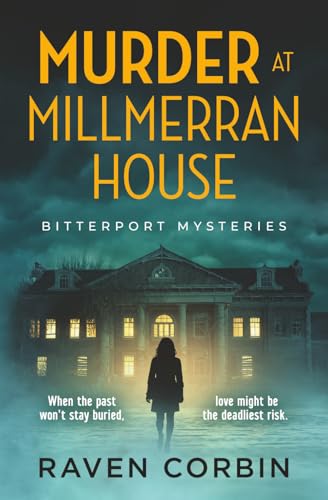
Murder at Millmerran House on special
. Would you like to share a short, spoiler-free excerpt?
Nina gripped the steering wheel as she turned left onto Main Street, her knuckles white. The GPS had lost signal twenty minutes ago, and the empty streets meant finding human help would be almost impossible.
The shoebox full of photographs her mother had given her lay on the seat next to her, a reminder of all the things she hadn’t known about until a letter from a lawyer in Hobart had landed in her mailbox. Like how her father’s family had come from a town called Bitterport. And her great-grandfather had died in the munitions factory explosion in 1943. Or that the Drake family had lost everything when her great-grandfather had borrowed money from someone named Arthur Carruthers, a man who’d owned most of the properties in town. Some of them acquired through questionable deals.
She’d read the history of the town on the Bitterport Historical Society website. She’d looked through the box of photos briefly, some labelled with fountain pen in her grandmother’s handwriting. Harvey at the Carruthers Munitions Factory, 1942. Great-aunt Constance, Matron at Moorstone Female Factory, 1840.
The GPS sprang to life again to announce the turnoff. A familiar prickling began at the base of her skull. The ghosts of Bitterport hadn’t waited long to make their presence known.
“Yeah, thanks for passing that gift on, Granny Violet. It’s the one thing I could really have gotten through life without.”
And now she had another one she didn’t want. She turned right onto Elizabeth Street and cruised past the Bitterport Service Station, boarded-up windows and police tape fluttering in the breeze. No hope of any real service there, only two credit card-activated, automated fuel pumps available to anyone who dared to stop long enough to fuel up. The sign on the door of the shop said it all. CLOSED. The police tape probably explained why.
Fenced-off ruins filled the block to her left. A giant skeleton of twisted metal, scattered bricks, and concrete covered in a blanket of weeds and grass. The battered sign said it had once been the old munitions factory. The place where her great-grandfather had shown up for work one day and never gone home.
She shivered as the hair on the back of her neck rose. Way too many souls waited for justice there.
The town centre ran the length of High Street, rows of abandoned buildings and boarded-up windows. Rose Mountwater’s Emporium where the sign hung at a drunken angle, a pub reclaimed by weeds. The old bank looked like it was getting a makeover.
Nina pressed harder on the accelerator. She’d assess Moorstone Manor, convince the lawyer to list it with the first real estate agent she could find, and be back in civilisation by the end of the week to redesign her client’s logo. Again.
Old Convict Road curved, and there it was. Great. This was what her mysterious benefactor had left her. A house and a prison complex in a ghost town clinging to the edge of nowhere.
Nina parked her rental car at the base of the steps on the least soggy patch of ground. Behind the main house, the old barracks and containment yards of the Moorstone Female Factory formed what had once been the gaol compound. The familiar sensation of being watched prickled at the base of her skull. She wasn’t alone, and not everyone was alive.
On the veranda, a man stood up out of a cane chair and walked towards her car. At least he was alive. George Denakis looked exactly like his voice—a dusty relic from the seventies, right down to his newsboy cap.


No comments:
Post a Comment